Georgia Open Records Act Framework
The Georgia Open Records Act sets a clear policy in favor of access. The core sections are O.C.G.A. § 50-18-70, § 50-18-71, and § 50-18-72. Agency records held by Fulton County departments are presumed open unless a statute or court order says otherwise. Response times, copy fees, and search fees are set by statute and may be charged within limits. Certain categories are exempt, including active investigations, medical records, security plans, and personal data.
The state Attorney General's open-government page is the entry point for guidance and a mediation program. Court records are a separate track; sealing and unsealing usually require a motion in the case rather than an open-records request.
How to File a Fulton County Public Records Request
A clean request gets a faster answer. Identify the custodian, describe the record, set a reasonable scope, and offer a payment method. Vague requests slow the process and may cost more in search fees.
- Identify the right custodian: Sheriff, Clerk, Probate, Tax Assessor, or another department.
- Describe the record narrowly: date range, type of file, parties, or department.
- Submit the request in writing through the agency's posted channel.
- Include contact information for response and pickup notice.
- Pay any lawful search or copy fee under O.C.G.A. § 50-18-71.
- Track the response window; the statute sets a short standard period for the first response.
- For court files, use the Clerk's file request form or eCertification.
- If access is denied, ask for the legal basis and consider Open Government mediation or court review.
Public Records Request Fields
An effective Fulton County public records request lists the same set of fields every time. The table below mirrors fields that most agencies require. Missing fields are a common reason for delay.
| Field Label | Type | Required | Notes |
|---|---|---|---|
| Requester Name | Text | Yes | Full legal name. |
| Contact Method | Email / Phone | Yes | Email is fastest for many agencies. |
| Record Description | Text | Yes | Be narrow; include type, date range, and any case or incident ID. |
| Custodian | Dropdown | No | Sheriff, Clerk, Probate, or other department. |
| Date Range | Date | No | Narrow date ranges reduce search fees. |
| Format Preferred | Checkbox | No | Inspection, plain copy, certified copy, or electronic delivery. |
| Fee Authorization | Checkbox | No | State a cap if you want to limit fees before approval. |
| Signature / Date | Signature | Yes | Required by some agency forms. |
Three Tracks of Fulton County Public Records
A strong Fulton public-records request matches the record to one of three tracks. Track one is agency records held by Fulton departments under the Open Records Act. Track two is court case records held by Clerks under court rules and statutes. Track three is statewide criminal-history records held by the GBI under separate criminal-history rules. The three tracks overlap, but they are not interchangeable.
A person who needs a Sheriff incident report uses the Open Records Act. A person who needs a divorce decree uses the Clerk. A person who needs a Georgia background check uses the GBI. Sending the wrong request to the wrong office often delays the answer even when the record is public.
Sheriff's Office Public Records
The Fulton County Sheriff's Office maintains agency records that fall under the Open Records Act. Incident reports, jail-policy records, certain operational documents, and administrative records may be obtained through a request. The Sheriff's Office page covers contact information for records requests.
Active criminal-investigation files often fall under an exemption while an investigation is open. Once a case is closed or disposition is reached, more material may be released. Identifying details, medical data, and victim safety information are normally redacted.
Clerk Records and Court Files
The Clerk of Superior and Magistrate Courts handles civil, criminal, family, and magistrate case files. Public court records run on court rules and case law, not on the Open Records Act. Smart Search, eCertification, and the Clerk's file request form are the right tools rather than an open-records request.
Fulton State Court has its own administrative records. Municipal courts inside the county have their own records offices. For traffic case files, see Fulton traffic court records.
Probate, Marriage, and Vital Records
Marriage licenses and certified marriage records are held by Fulton County Probate Court. Estate, guardianship, and conservatorship records are also held by Probate Court. The Fulton probate records page covers the request path. Statewide vital-records verifications are separate and run through the Georgia Department of Public Health.
Birth and death certificates are issued by DPH, not by the county Clerk. A user who needs a Fulton birth certificate should go to the state vital-records office or to a Fulton DPH office, not to the courthouse.
Open Records Fees
The Open Records Act allows agencies to charge fees for search, retrieval, redaction, and copying. Fees must follow the statutory rules. Many records can be inspected without fee, but copies typically carry a cost. The table below maps the common categories used by Fulton agencies. For court records, the Clerk's fee schedule controls instead.
| Item | Common Fee Basis |
|---|---|
| Inspection of public records | Often no fee; verify with the custodian. |
| Search and retrieval time | Hourly rate above a short free period under state law. |
| Plain copy | Set by agency or court fee schedule; Clerk plain copy is $0.50 per page. |
| Certified copy | Higher fee; Clerk certified copies are $2.50 first page and $0.50 each added page. |
| Electronic delivery | Some agencies waive paper costs but may charge for processing. |
| Redaction time | Time spent removing protected fields may be charged where allowed. |
Response Times and Denials
State law sets a short standard period for the first response to an Open Records Act request. The agency must produce the records, give a date for production, or explain why they are withheld. A denial must point to a legal basis. Common bases include active investigations, medical records, personal data, and security plans.
If a denial does not match the law, options include the Georgia Attorney General's Open Government mediation program and a court action. The state framework on law.georgia.gov covers next steps in plain English. For sealed court files, the path runs through a motion in the case rather than an open-records review.
Federal Records in Fulton County
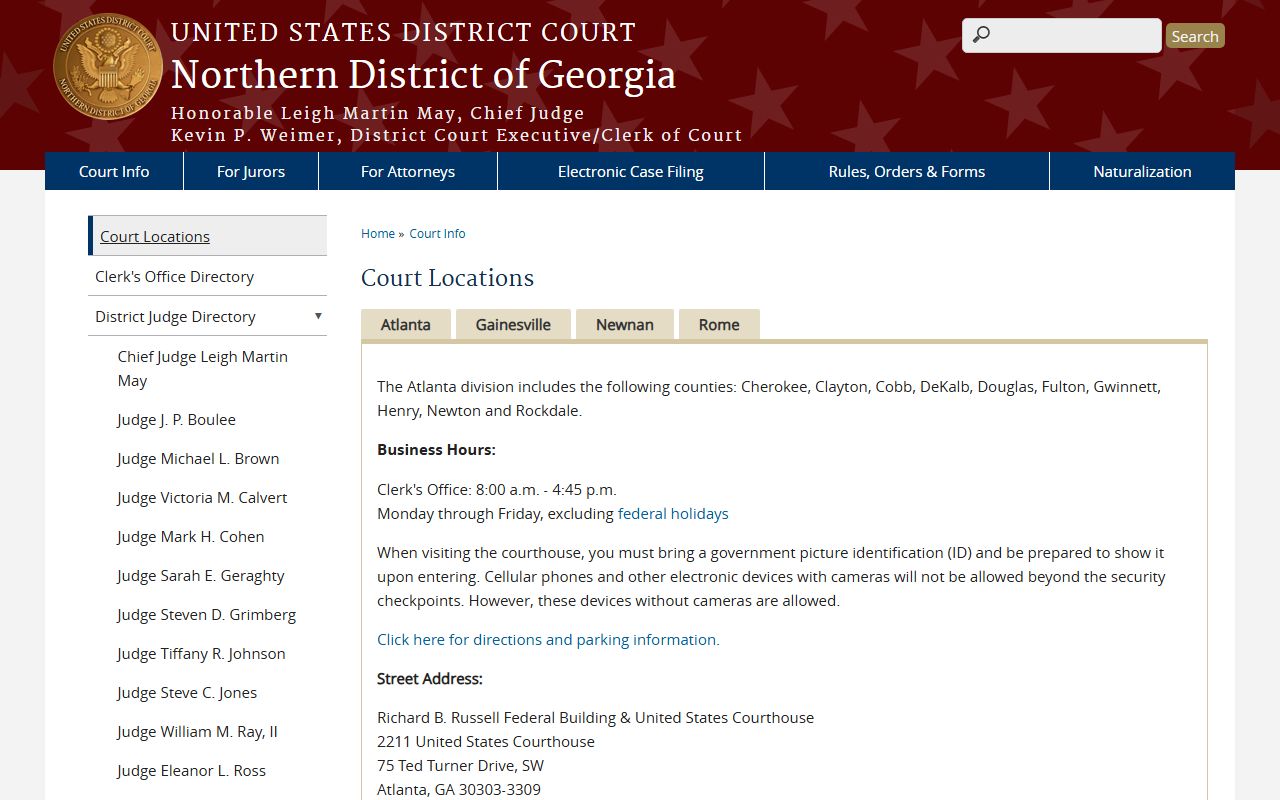
Federal records held by the U.S. District Court for the Northern District of Georgia and the U.S. Bankruptcy Court are not Fulton County public records. They are searched through PACER, and they follow federal Freedom of Information Act rules when the request is to a federal agency. The Richard B. Russell Federal Building in Atlanta is the main federal courthouse.
Federal arrest and custody records may sit with the FBI, the U.S. Marshals, or the federal Bureau of Prisons depending on the stage. State and county Open Records Act tools do not reach those records, even when the case took place in Atlanta.

Visiting Fulton Records Offices
A walk-in records visit is sometimes the fastest path, especially for a one-off request. The Fulton court campus sits near downtown Atlanta close to MARTA. The MARTA transit site covers current rail and bus schedules for trips to the Government Center, Justice Center, Probate Court, and Juvenile Court offices.