
Why Fulton Uses Superior Court
Georgia uses Superior Court as its main trial court of general jurisdiction. The state does not have a county-level "District Court" the way some other states do. In Fulton County, Superior Court is the court for felony prosecutions, divorce, equity matters, title to land, and major civil litigation. Smaller misdemeanor and traffic cases go to State Court. Warrants, small claims, and first appearances go to Magistrate Court.
The court site is at fultonsuperiorcourtga.gov. The court covers all of Fulton County and operates from the downtown court campus near Pryor Street and Central Avenue.
Fulton Superior Court Jurisdiction
Superior Court's authority comes from the Georgia Constitution and the Georgia Code. It hears felony criminal cases, divorce and domestic relations, equity claims, real estate title disputes, and civil cases above the limits set for State Court and Magistrate Court. The court also reviews many lower-court matters on appeal or by writ.
| Division | Main Role | Common Cases |
|---|---|---|
| Civil Division | Major civil suits | Personal injury, contract, business, premises liability |
| Criminal Division | Felony cases | Indictments, accusations, trials, sentencing |
| Family Division | Divorce and domestic relations | Divorce, custody, child support, legitimation, modifications |
| Business Court | Complex commercial cases | Business disputes, equity, complex commercial litigation |
Superior Court Civil Division
The Civil Division of Fulton Superior Court hears the largest civil suits in the county. Common cases include personal injury claims, contract disputes, premises liability, commercial litigation, and post-judgment proceedings. Filing fees and copy fees follow the Clerk's published schedule. The standard civil filing fee is $218.00 on the current Fulton Clerk fee schedule.
Civil cases run through the Georgia Civil Practice Act and the Uniform Superior Court Rules. Many filings now happen through Odyssey eFileGA. Public access to civil files goes through Smart Search on the Tyler Portal.
Superior Court Criminal Division
The Criminal Division handles felony cases after an arrest is reviewed by the District Attorney. The grand jury can return an indictment; the prosecutor can also file an accusation in some cases. Once a case is filed, the court handles arraignment, motions, trial, plea, and sentencing. Probation, restitution, and post-conviction matters also run through Superior Court.
For the broader criminal-case path from arrest to disposition, see Fulton County criminal records. Misdemeanor and traffic cases go to State Court instead. The criminal docket is part of the public record except where the case is sealed or restricted under state law.
Superior Court Family Division
Family Division hears divorce, custody, child support, legitimation, and modification cases. The official Family Division page covers division contacts and standing orders. Family cases follow Georgia domestic relations statutes and special rules for child-related matters.
The standard divorce filing fee is $223.00 on the current Fulton Clerk fee schedule. Certified divorce decrees go through Clerk eCertification. For more on family records and decrees, see Fulton marriage and divorce records.
Fulton Business Court
Business Court is a specialty division for complex commercial and business cases. The division uses calendar management, scheduling orders, and dedicated case-management practices for cases that fit the program. Business Court records run through the same Clerk of Superior and Magistrate Courts and appear in Smart Search like other Superior cases.
Eligibility depends on case type, parties, and amount. Lawyers usually screen the matter for Business Court at filing. The court page covers current intake criteria.
Superior Court vs State Court vs Magistrate
Many Fulton users mix up the three trial courts. The comparison below sums up the splits. Each row shows where a case would normally land based on the type and amount.
| Feature | Superior Court | State Court | Magistrate Court |
|---|---|---|---|
| Authority | General jurisdiction trial court | County state-court division | Limited civil and early criminal stage |
| Criminal Cases | Felony | Misdemeanor and traffic | First appearance, warrants, preliminary hearings |
| Civil Cases | Major civil, equity, title | Civil within state-court limits | Small claims and dispossessory |
| Family Cases | Divorce and custody | Limited if any | Generally none |
| Appeals From | Lower courts within authority | Within state-court reach | To State or Superior under rules |
How a Fulton Superior Court Case Moves
A felony case usually starts with an arrest, then a first appearance in Magistrate Court, then a prosecutor decision to indict or file an accusation. Once the charge is filed, the case routes to Superior Court for arraignment, motions, plea or trial, and sentencing. A civil case starts with a complaint filed through the Clerk, then service on the other party, an answer, discovery, motions, and finally trial or judgment.
Process diagram: Arrest or Complaint › Filing with Clerk › Service › First Appearance or Answer › Motions › Trial or Plea › Judgment or Sentence › Appeal.
Each step adds a docket entry. The full record sits with the Clerk of Superior and Magistrate Courts. For docket-reading help, see Fulton County court dockets.
Atlanta Judicial Circuit and Appeals
Fulton County Superior Court is the Atlanta Judicial Circuit. Most appeals from a Superior Court ruling go to the Court of Appeals of Georgia. Some cases, such as cases involving capital punishment, election contests, and certain constitutional issues, go directly to the Supreme Court of Georgia. The Court of Appeals can also send a case up to the Supreme Court under Georgia appellate rules.
Federal appeals from the Northern District of Georgia go to the U.S. Court of Appeals for the Eleventh Circuit, but that is a separate track from state appeals.
Superior Court Judges and Calendars
The Fulton Superior Court bench includes a panel of elected judges who run civil, criminal, family, and business calendars. The official judge directory covers the current bench and judge-specific information. Court calendars are published through the Clerk's eServices and the court's own site.
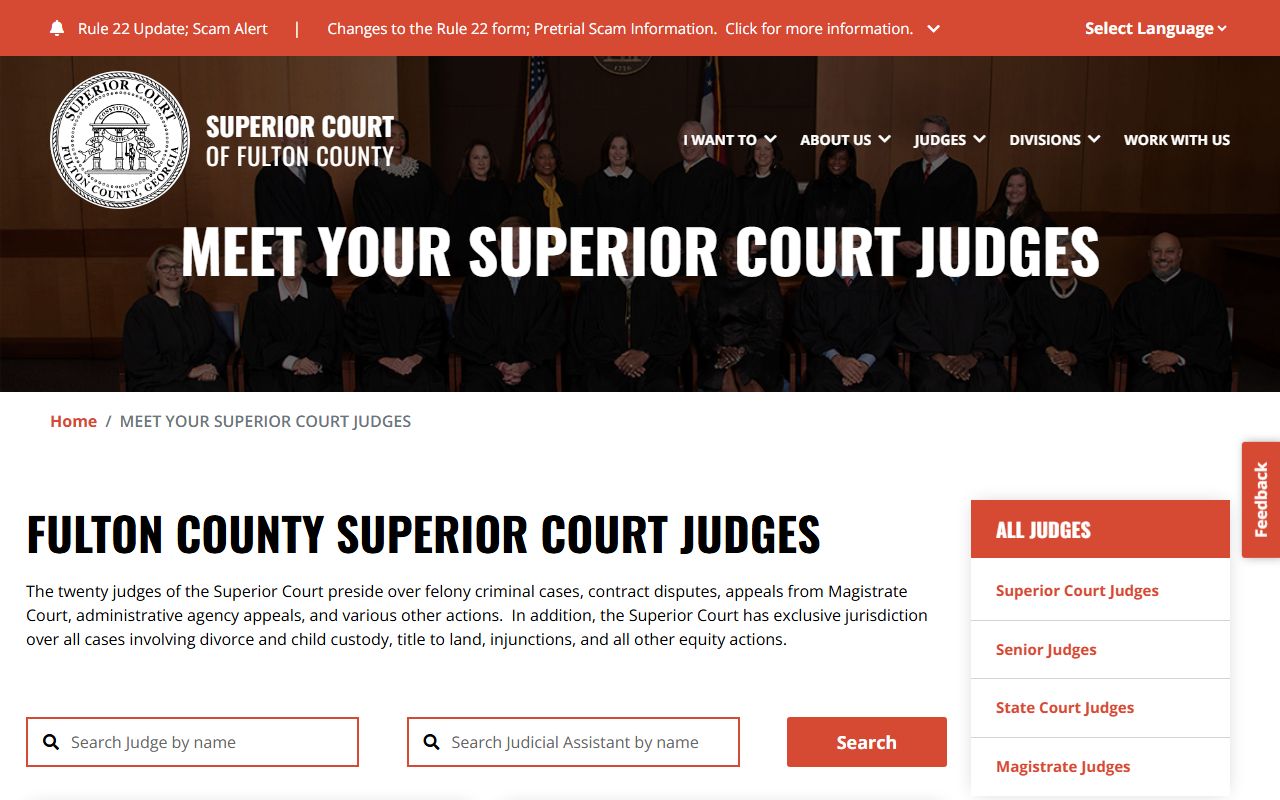
Calendar management can vary by judge. Lawyers and self-represented parties should always check the assigned judge's standing orders before a hearing.
Federal District Court Is Different
"District Court" in Fulton County usually means the federal U.S. District Court for the Northern District of Georgia, not a state court. Federal cases are not searched in the Fulton Clerk portal. They live on PACER. The Russell Federal Building in downtown Atlanta houses the federal court.
For court records by case number or party, see Fulton County court records. For Clerk services that back the Superior Court file, see Clerk of Superior and Magistrate Courts.